

First-Order MOQ: Test Samples Before a $28,000 Bulk Commitment
Separate sample approval, demand testing and total cost before accepting a 2,000-unit MOQ. Use seven decision steps and eight questions to size a first order.
A first-order MOQ of 2,000 units at $14 each means a $28,000 product commitment before you know what the quotation excludes. The useful first question is how much evidence you can buy before buying that much inventory. Separate three decisions: whether the supplier can make the product, whether customers will pay for it, and whether this order fits your cash and inventory limits.
The case behind this guide involved an undisclosed custom product and a buyer who believed only one manufacturer could make it. The quoted delivery term was not established. The case dates to January 2026; no final order or sales outcome is established. The figures describe that case, not typical prices or a recommended order size. The workflow below is an editorial decision aid, not a report of a supplier audit or product test.
1. Ask what the $14 quotation actually includes
Request a dated quotation tied to a product specification and quantity. Ask for the delivery rule, version and named place or port, plus an explicit list of inclusions and exclusions. Do this before comparing unit prices.
ICC explains that Incoterms rules allocate delivery tasks, costs and risks. The U.S. International Trade Administration distinguishes rules for any transport mode from rules restricted to sea and inland waterways. EXW means Ex Works; DDP means Delivered Duty Paid. FOB means Free on Board and CIF means Cost, Insurance and Freight; the latter two belong to the sea/inland-waterway group. These labels are not interchangeable descriptions of an all-in price. Use a forwarder or customs adviser to confirm the responsibilities for your actual route, destination and importer arrangement.
Ask separately about export handling, international transport, insurance, import clearance, duties, taxes and final delivery. Do not assume the case’s $14 was EXW, FOB, CIF or DDP. Also request packaging specifications, carton dimensions and weights, payment milestones, quotation validity and the event that starts the production lead time.
The case included a claimed $30 sample offer. That is neither a current quotation nor a benchmark. Before paying for your own sample, obtain its scope: stock item, altered stock, prototype or production-process sample; included revisions; freight; ownership; and whether any fee is credited against a later order. A credit is a written commercial agreement, not an automatic entitlement.
2. Ask why the MOQ is 2,000
Treat explanations as hypotheses to test with this manufacturer. Do not infer a motive from the quantity alone. Request a breakdown that distinguishes a material minimum, a machine setup or production batch, tooling, packaging and a commercial minimum for a new account.
| Possible constraint to ask about | Evidence to request | Smaller commitment to price separately |
|---|---|---|
| Material or colour minimum | Material specification, purchase increment and unused-material treatment | Existing material or colour, if it still meets the specification |
| Production setup | Setup charge and minimum efficient run for this process | Paid setup with a shorter run |
| Tooling | Itemised tooling cost, ownership and permitted use | Prototype route and production tooling quoted separately |
| Packaging minimum | Packaging specification and order increment | Plain packaging for a permitted pilot |
| Commercial minimum | Quantity tiers, unit-price changes and payment conditions | Trial quantity at an explicitly quoted premium |
These are questions, not established reasons for this supplier’s position. If the factory cannot separate the constraint, request comparable quotations elsewhere with the same specification. A smaller quantity may cost more per unit; decide from total exposure rather than insisting on the original unit price.
If tooling prevents an economical pilot, ask an appropriate engineer whether an alternative prototype process can answer the specific design question. A prototype made by another process does not establish production-process capability. Do not assume 3D printing, shared material runs or a changed material is technically suitable.
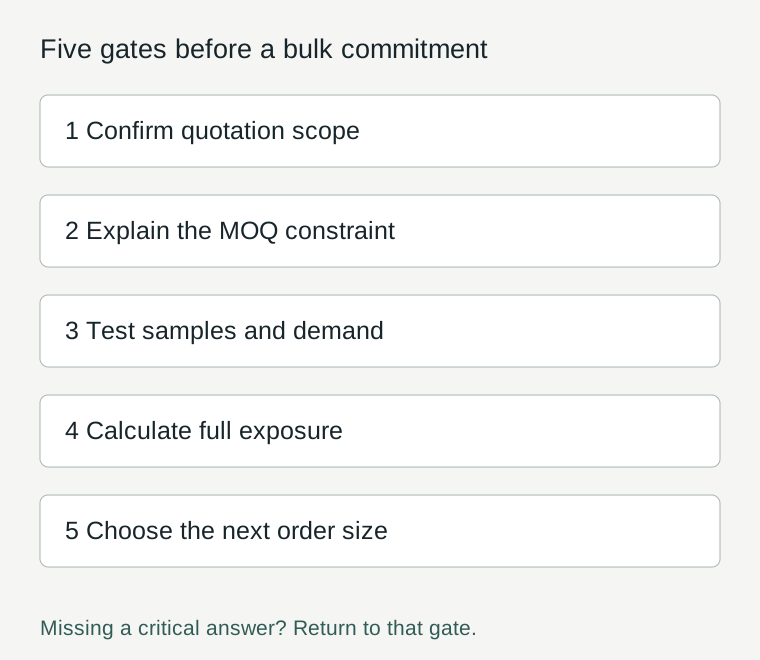
Five gates before a bulk commitment
3. Buy samples to answer defined questions
Write the questions before ordering: dimensions, fit, function, finish, material identity, packaging or a particular failure mode. Define acceptance criteria and decide which questions require a competent laboratory rather than visual inspection. Record what the sample was made from and which process produced it.
A prototype can help evaluate a concept. A production-process sample can establish a reference for the specified revision. Neither proves that a future lot will match it. QIMA describes product inspections at different production stages and checks against agreed product requirements; that is a separate activity from accepting an early sample. Use the existing golden sample approval guide to control the physical reference and its linked documents.
Keep technical approval and demand testing separate. Customer enthusiasm for a photograph cannot establish material performance. A technically satisfactory sample cannot establish willingness to buy.
Choose a trial quantity from a written learning plan: who will evaluate it, which sales channel will be tested, how long the test runs, what result would justify continuing, and the maximum loss you will accept. Allow for samples used in testing, shipping damage and unsold goods. There is no universally correct pilot quantity. Do not treat quantities suggested by other buyers as an industry standard.
4. Compare the full cost with a tested selling-price assumption
Start with the product quotation, then add separately quoted or estimated costs without double counting costs already included in the delivery term. Label estimates and identify who must replace them with quotations.
| Cost group | What to record |
|---|---|
| Product and development | Units, tooling, setup, samples, revisions and packaging |
| Logistics and import | Origin handling, freight, insurance, clearance, duties, applicable taxes and delivery |
| Quality and compliance | Product-specific testing, inspections and any corrective work |
| Selling and fulfilment | Photography, website or marketplace fees, payment fees, acquisition, picking and shipping |
| Inventory and after-sales | Storage period, returns, replacements, unsold stock and disposal |
Cash paid before the first sale is not the same as profit per unit. Prepare both a cash timeline and a contribution calculation. Separate one-time development costs from recurring costs, and distinguish tax cash outflows from recoverable taxes with qualified advice. Use destination-specific classification and customs advice rather than a generic percentage uplift.
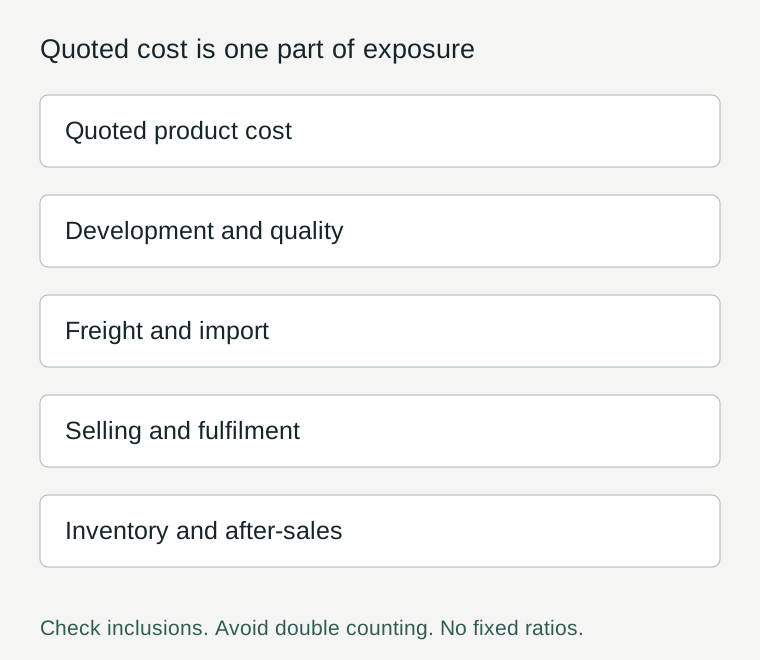
Quoted product cost and additional cost groups
The case’s proposed $140 selling price was an untested assumption. A large difference between purchase price and selling price does not establish margin or demand. The SBA recommends researching demand, market saturation, customer alternatives and pricing, using both existing information and direct customer research.
For your test, identify the buyer, the alternative they would otherwise purchase and what makes your offer worth its price. Show the actual product and price to the intended audience. Record the test channel and distinguish interviews, sign-ups and paid purchases. Define the evidence threshold before seeing the result; do not relabel interest as sales. If accepting orders, confirm fulfilment and consumer obligations for that market first.
5. Challenge the “only one factory” assumption
Separate “only one has responded convincingly” from “no other supplier can make this specification.” Send a bounded brief to additional candidates and compare technical questions, manufacturing evidence, sample scope and commercial terms. The first-order supplier screening checklist covers the identity and transaction checks; this article’s decision is the size and sequence of the commitment.
If considering a factory visit or independent audit, define the questions it must answer. QIMA’s supplier-audit description includes capacity and quality-management assessments. An audit of a facility does not validate market demand or guarantee a later shipment. Ask who performs the work, which legal entity and premises will be visited, what evidence the report includes, and how findings will be followed up.
For an agent, ask for written scope, fee basis, supplier relationships, payment handling, inspection arrangements and responsibility for errors. Obtain a quotation for that scope. No commission rate, visit fee or delivery-cost multiplier from this case establishes a market price.
6. Choose the next commitment
| Decision | Trigger | Next action |
|---|---|---|
| Continue negotiating | Technical fit looks plausible but the MOQ constraint or included costs remain unclear | Obtain a revised quotation and a separately priced trial |
| Reduce the first order | A defined trial can resolve important uncertainties within your loss limit, and the supplier agrees | Approve only that scope, specification and quantity |
| Compare another supplier | Essential evidence is withheld, identity cannot be verified, or suitable alternatives may exist | Send the same brief and compare the evidence |
| Pause the purchase | Demand, total exposure or technical feasibility remains too uncertain | Close the specific evidence gap before committing to inventory |
A good supplier can still be the wrong supplier for your first-order scale. A high MOQ alone proves neither bad intent nor production capability. Walk away from the proposed quantity if the smallest acceptable commitment exceeds your agreed loss ceiling or depends on sales you have not established.
7. Eight questions before authorising an order
- What exact specification and revision will the supplier manufacture?
- What delivery rule, version and named place apply, and which costs are excluded?
- What creates the minimum quantity, and which smaller alternatives have written prices?
- What will the sample prove, how will it be assessed, and what remains untested?
- What evidence supports demand at the intended selling price and sales channel?
- What is the total cash exposure, including unsold stock and after-sales obligations?
- Who will verify supplier identity, production conformity and any product-specific compliance requirements?
- What finding stops the order, and who can authorise the next payment or quantity?
If a critical answer is missing, pause the affected commitment. Assign an owner and the evidence needed to resolve it. Do not let a sample fee already paid become the reason to accept an unaffordable bulk order. The first order should buy a manageable next step supported by evidence, rather than force the evidence to justify 2,000 units.
Sources
- Reddit discussion · r/Alibaba · 53 comments
- International Chamber of Commerce — Incoterms rules.
- U.S. International Trade Administration — Know Your Incoterms.
- U.S. Small Business Administration — Market research and competitive analysis.
- QIMA — Product Inspections; Supplier Audits.
Sourcing information earns its value when it is verified, compared and turned into a decision.
Questions & discussion
Share a question or a useful experience about this guide. Comments appear immediately. Your name and comment are public. Email is optional and stays private; reply emails are not enabled yet. Comment privacy.