
Private Label Brands: Examples and a Buyer's Sourcing Plan
Explore nine private label brand examples, then plan your own product, factory brief, packaging MOQ, compliance responsibilities and production checks.
Private label means a factory makes a product that a buyer sells under the buyer’s own brand. Examples range from retailer food and household ranges to clothing labels and independent Amazon seller products. This guide groups nine examples by category, then turns the model into a sourcing plan: define the product, choose a manufacturing route, separate product and packaging minimums, assign brand and compliance responsibilities, approve samples, and check the production batch. Start with the customer problem you can specify and inspect; a logo alone gives a factory little direction.
Private label brand examples by category
These examples show different brand owners and product categories. They are not ranked or recommended suppliers. A public brand page establishes the brand relationship and assortment; it does not establish a particular factory, manufacturing country, exclusivity agreement or specification. Do not assume that a similar catalogue item comes from the same production line.
Food and groceries
- Good & Gather — Target. Target identifies this as its food brand, covering products such as dairy, produce and prepared foods. Source: Target’s brand directory.
- Kirkland Signature — Costco. Costco identifies Kirkland Signature as its private label; its brand page includes food alongside other merchandise. Source: Costco’s Kirkland Signature overview.
For a sourcing brief, treat an ingredient list, declared quantity and pack format as separate specifications. A food example explains brand ownership; it does not make food an appropriate first product for every buyer.
Home and everyday essentials
- Threshold — Target. Target describes Threshold as a home assortment for decorating and furnishing. Source: Target’s brand directory.
- up&up — Target. Target’s everyday essentials brand includes home items, personal care and food storage. Source: Target’s brand directory.
- Amazon Basics — Amazon. Amazon identifies Amazon Basics among its own brands offering frequently purchased household essentials. Source: Amazon’s everyday savings overview.
Translate the intended use into measurable requirements. A storage product needs dimensions and closure checks; a textile needs material and construction details. Sharing a retail category does not mean sharing the same inspection method.
Clothing and children’s apparel
- Cat & Jack — Target. Target identifies Cat & Jack as a children’s apparel and accessories brand. Source: Target’s brand directory.
- Amazon Essentials — Amazon. Amazon identifies Amazon Essentials as a brand for clothing staples. Source: Amazon’s everyday savings overview.
For apparel, specify the size chart, fabric composition, construction and label placement before comparing quotations. A photograph cannot establish fit or how the garment behaves after washing.
Independent Amazon seller case studies
- Jungle Stix — Jungle Scout’s seller project. Jungle Scout’s published case study describes its private label marshmallow sticks sold through Amazon. Source: Jungle Scout’s case study.
- Jungle Snugs — Jungle Scout’s seller project. The same first-party account describes its private label hooded baby towels. Source: Jungle Scout’s case study.
These are historical launch examples documented in 2017, rather than statements about current availability or ownership. They show that a seller can build a focused product identity without owning a retail chain. They do not establish a repeatable profit, launch schedule or suitable factory for your order. Children’s products also need their own applicable safety assessment.
Turn the customer problem into a product brief
Choose a use case narrow enough to describe without a competitor’s logo. For example, a buyer sourcing a washable travel pouch could define the intended contents, usable dimensions, fabric, closure, cleaning method and packaging. Ask what customers would notice if the supplier changed a component. Those details belong in the brief.
Build a comparison sheet containing the proposed material, dimensions, tolerances, finish, intended user, destination market and acceptance checks. Mark unresolved items as questions. Ask suppliers to answer against the same revision so that a cheaper quotation cannot quietly substitute a different construction.
Separate requirements from preferences. A required closure strength needs a defined check; a preferred colour needs an agreed reference. Record which changes would force a new sample. This gives you a way to reject an attractive product that fails the actual use case before paying for branded packaging.
Choose the factory route by the changes you need
Request alternatives from suppliers against that brief. For an existing product with an existing mould, ask exactly what can change: logo application, colour, accessory, insert or outer packaging. Get written confirmation that the offered design and branding arrangement can be used for your intended market. An existing mould does not establish exclusive rights.
For an ODM proposal, identify the supplier’s starting design and the changes it will engineer. For an OEM proposal, identify the drawings and specifications you supply and the manufacturing work requested. Suppliers use these labels differently, so make the quotation list the deliverables, tooling rights, design permissions and change responsibilities. Use the existing OEM, ODM and private label comparison to choose the route without relying on the label alone.
Ask which production steps the quoted factory performs and which it subcontracts. Request evidence relevant to your product, then verify the legal supplier and proposed production site. Keep design ownership, tooling access and permission to use catalogue components in the written agreement.
Separate product MOQ from packaging MOQ
Ask for minimum order quantities by finished product, colour, size, component and packaging format. Request separate quotations for stock packaging with an approved label, a printed sleeve, and a fully printed carton. Ask which minimum comes from the assembly line and which comes from a packaging or component supplier.
A small finished-goods order can still leave you holding unused printed boxes. Specify who owns surplus packaging, where it will be stored, how it is counted and whether it can be used only for your orders. Agree what happens to obsolete labels when artwork changes.
Check the physical packaging before approving a print run. Confirm product fit, internal protection, barcode placement, required warnings and carton identification. Request a packed sample and the final artwork revision together. If the supplier changes the product dimensions, reopen the packaging check rather than assuming the approved box still fits.
Assign trademark and compliance responsibilities
Name the person responsible for clearing the proposed brand in each intended market before ordering permanent branding. Search for similar names and relevant goods, rather than checking only whether a domain is available. For the United States, the USPTO explains that clearance involves more than its federal trademark database. Escalate uncertain results to a qualified adviser before committing to artwork.
Create a responsibility sheet for product requirements, testing, certificates, labels, traceability and retained records. Ask a competent compliance specialist to identify the rules for the product and destination. Have the factory supply the underlying product and test information; identify the party legally responsible for placing the goods on that market. A supplier’s promise to handle everything is not a completed responsibility sheet.
For example, the CPSC’s GCC guidance identifies certification responsibilities for applicable general-use products imported into the United States. That example is not a universal certificate requirement for every product. Confirm the applicable regime, responsible entity and supporting evidence for your exact item. Match reports to the model, materials and construction being purchased; investigate any mismatch before accepting them.
Make the approved sample reproducible
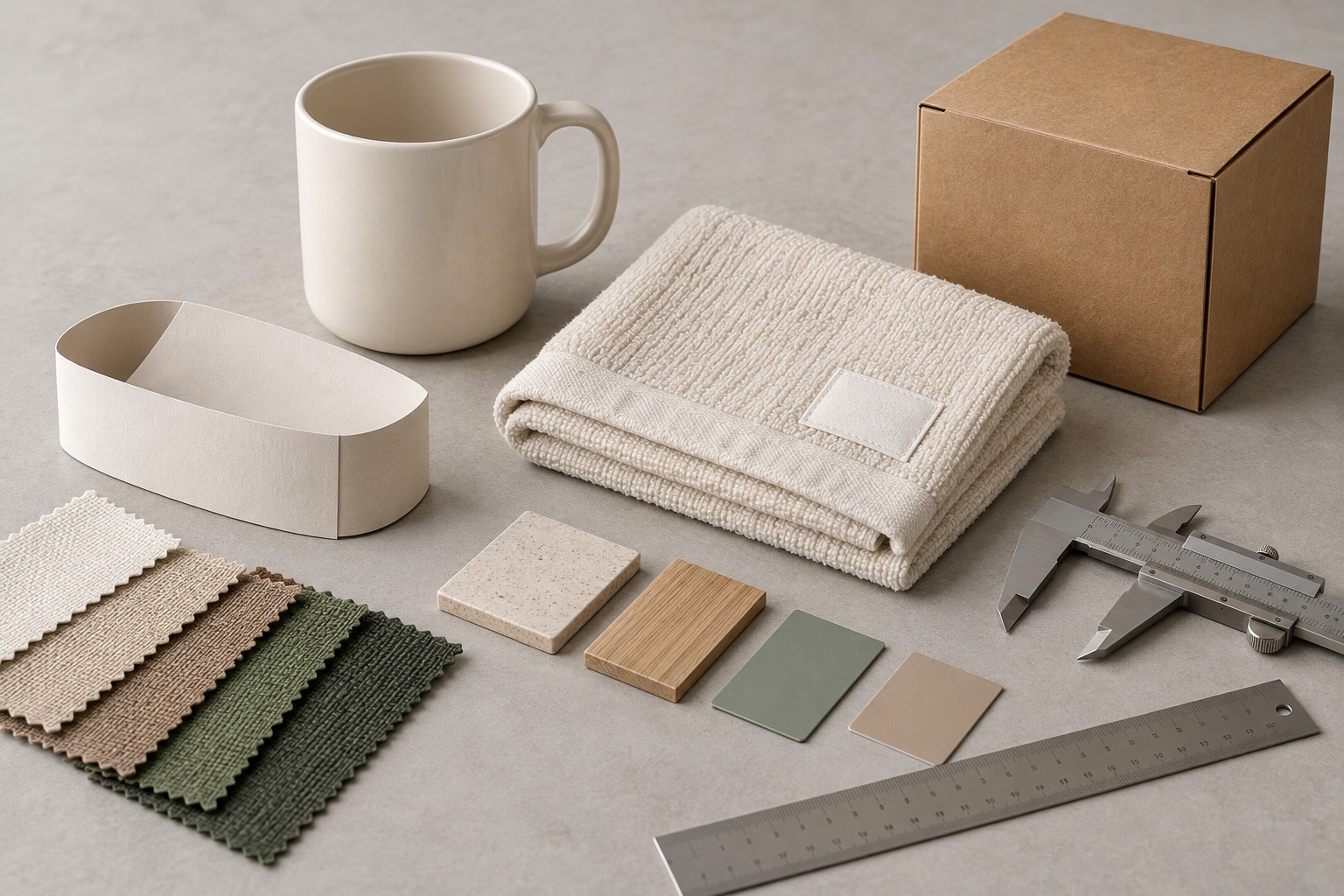
Ask for a sample made with the proposed production materials, branding and packaging. Record its revision, component list, measurements and agreed acceptance checks. Keep a retained reference and have the supplier confirm what production must match. Document acceptable variation with photographs and measurements where useful.
Test the product against its intended use and arrange specialist testing where required. For a textile, define the wash method and the properties you will compare afterward. For an assembled item, define fit, operation and finish checks. A presentation sample proves little about repeatability unless the supplier can reproduce its construction.
Put the final specifications, artwork and sample reference into an order pack. The private label sourcing brief guide helps turn those decisions into supplier instructions. Require written acceptance of substitutions and design changes before they enter production.
Check the batch and start with a manageable order
Agree an inspection plan before production starts. Identify the characteristics that matter, how units will be selected across the batch, what constitutes a defect and who can authorize shipment. Request checks of the actual branded goods and packaging, including variants and carton identification. A supplier’s photograph of a single unit cannot establish that the batch matches.
Compare inspection records with the approved sample and order revision. Record shortages, defects and substitutions separately. Agree corrective action, reinspection and release responsibility in writing. Keep the evidence linked to the batch so that a later complaint can be traced to the goods actually shipped.
For a smaller start, request an existing construction with a limited variant range and simple branding. Compare an available stock item with a label or sleeve against a custom production order. Ask whether a shared material or existing component reduces the minimum without changing your requirements. Check permissions and compliance for either route.
Set your next-order decision before placing the first one: which defects, customer responses and stock records will justify repeating, revising or stopping the product? Retain the same specification history when reordering. Increasing volume while quietly changing fabric, components or packaging makes it harder to understand what customers actually accepted.
Private label starting checklist
Keep these decisions beside your order documents. Browse the private label sourcing collection as you develop the manufacturing route and supplier brief; resolve the unanswered checks before increasing the commitment.
Sources
- Target brand directory — Good & Gather, Threshold, up&up and Cat & Jack
- Costco — Kirkland Signature
- Amazon — everyday savings and its Amazon Basics and Amazon Essentials brands
- Jungle Scout — Jungle Stix and Jungle Snugs seller case study
- USPTO — comprehensive trademark clearance searches
- CPSC — General Certificate of Conformity FAQ
Questions & discussion
Share a question or a useful experience about this guide. Comments appear immediately. Your name and comment are public. Email is optional and stays private; reply emails are not enabled yet. Comment privacy.