

Alibaba Supplier Signals From a Self-Described Trading Insider
Use an Alibaba AMA’s supplier signals carefully, weigh factory control against trader support, and verify medical-device FDA claims independently.
Should the supplier advance beyond your initial shortlist?
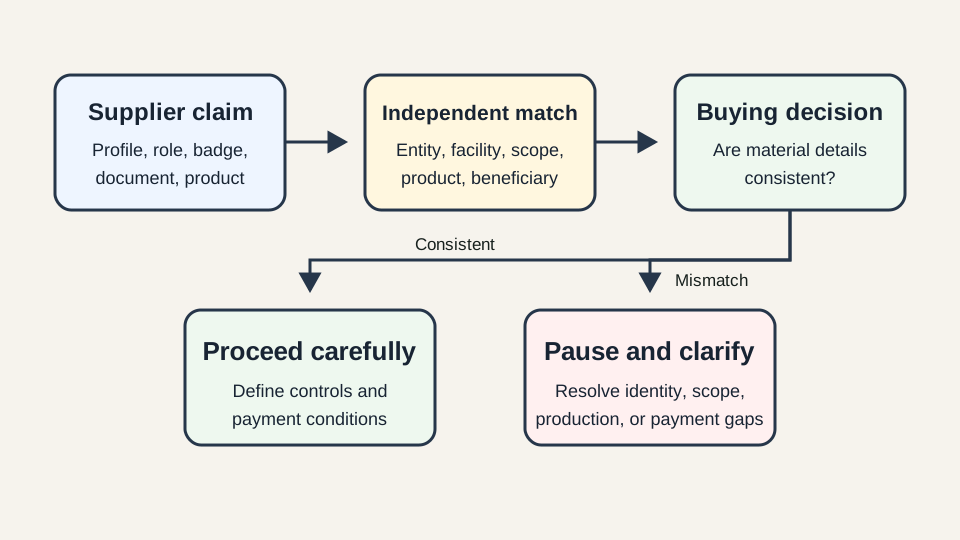
Imagine that an Alibaba seller claims to be a factory, offers DDP shipping, and sends an FDA-looking document before requesting a deposit. The immediate decision is not whether the profile feels credible, but which claims must be matched to independent records and written order terms. The site’s supplier-screening guide gives the governing threshold: Proceed only when the supplier’s identity, payment beneficiary, product claims, and transaction documents are consistent. The AMA’s signals can help decide what to investigate, but not whether to pay.
In the r/Alibaba AMA, the poster repeatedly described supplier credibility through a combination of personal signals. He said a short platform history, such as a brief period, required additional checking. He looked at whether the requested product matched the shop’s apparent main business instead of appearing among unrelated offerings. His other stated signals were accumulated reviews and the speed of the supplier’s replies. He also preferred suppliers located close enough for him to visit. These were his personal selection preferences, not Alibaba platform rules, and the discussion did not independently verify suppliers selected through them.
The source itself deserves limited weight. The poster described himself as an American who had lived and worked in China for nearly 15 years, worked for a Shenzhen trading company, and used Alibaba hundreds of times to find suppliers. The thread offered no evidence confirming his identity, employer, claimed order history, or experience. His claimed employment by a trading company also suggested a potential commercial interest in the conversation.
The discussion snapshot dated 2026-10-14 recorded 244 comments. About 100 comments were examined from the Best-ranked discussions and expanded replies, not every comment on the page. The reviewer described many remaining visible requests as repetitive, but those comments were not reviewed individually. Within the material reviewed, roughly half consisted of sourcing requests, thanks, short replies, or exchanges without detailed buyer experience. A smaller share contained explicit self-promotion, while the reviewed comments did not show public contact details being posted. The opening post was an invitation rather than a fixed agenda, so buyer questions largely determined the discussion’s direction.
Treat profile age, product-range fit, reviews, reply speed, and visitability as screening clues. A short history calls for independently checking the legal entity and displayed transaction record; a product-range mismatch calls for evidence connecting the seller, production site, and exact product. Reviews and quick replies cannot justify a deposit. If a visit is impractical, decide whether the material capability claim needs a remote or on-site audit. As the supplier-screening guide states, No badge, review, document, video, or reassuring message proves reliability by itself.
Who should control inspection and freight before payment?
In a long exchange about trade terms, the poster supplied his most complete sequence of suggestions. He said the buyer could arrange outside-party inspection before payment or travel to China personally. He then suggested requesting an EXW price from the factory, obtaining the carton count together with weights and dimensions, and seeking a separate quotation from a freight forwarder.
The poster also said that a buyer using DDP should ensure that the correct HS code was used. The discussion supplied no destination-specific customs or tax source supporting that statement. His inspection and freight suggestions did not identify qualification standards for providers, name service providers, define an inspection scope, or give fee ranges. The exchange therefore recorded the order of his preferred steps without supplying a complete operating standard for selecting or instructing an inspector or freight forwarder.
Keep control of appointments and comparisons rather than accepting a bundled assurance. Ask the supplier for the carton count, dimensions, weights and production access; appoint and instruct the inspector yourself when following the poster’s independent-inspection approach, and obtain the separate freight quotation directly. Record the inspection scope, acceptance criteria, result and agreed response to failure before the relevant payment stage. The supplier-screening guide cautions: Do not rely on a general statement that inspection is “accepted.” Ask for destination-specific support for the proposed HS code. Keep payment on hold while the material acceptance conditions remain unresolved; the guide states, “Do not send funds while a material discrepancy remains open.”
Should you buy from a factory or a trading company?
The AMA contained an internal tension rather than a developed debate. Although the poster said he worked for a trading company, he also said he preferred dealing directly with factories because he believed direct contact gave him greater control. That was his own position, not a conclusion independently established by the thread.
He nevertheless acknowledged that a trading company could be useful when a buyer lacked time to conduct all the research independently. Elsewhere, a buyer seeking game-machine repair parts for Italy requested a trading company or wholesale partner and received no substantive answer. The discussion therefore contained a preference for factory contact, a limited acknowledgment of a trader’s role, and an unanswered request for an intermediary. It did not establish that either factories or trading companies were generally more reliable.
The insider’s preference does not settle your choice. Use the factory-and-trading-company guide to examine the role you actually need: neither label determines quality or compliance. The AMA adds a narrower question—whether you want direct contact or need the research support the poster acknowledged—while leaving the requested intermediary recommendation unanswered.
Which buying questions still need your own answer?
Several questions in the AMA concerned material transaction gaps rather than general sourcing curiosity. A commenter asked whether a small buyer could receive fair tiered pricing from a frontline factory through Alibaba, but the poster gave no substantive response. Another asked whether supplier selection should rely mainly on Trade Assurance or an in-person factory visit; that comparison was not answered directly. A question about whether Alibaba remained the most efficient starting point received only a courteous response.
A buyer also asked whether a minimum order could be reduced from 500 units to 100 while retaining the original unit price. The reply appeared mistranslated or unrelated, leaving both quantity and price unresolved. These silences did not establish whether the requested price, quantity, or protection was favorable. They left the buyer without a documented answer.
The most consequential unanswered question asked how manufacturer certificates could be verified when FDA or GMP documents might have been altered using image editing. No participant supplied a verification method. The discussion also did not independently verify any specific company or supplier name appearing in its comments.
Separate a negotiating question from missing order terms. A requested MOQ reduction can remain under discussion, but your agreed order still needs a defined quantity, price and specification. Resolve material identity, acceptance, regulatory-status and protection-term gaps before payment rather than treating the AMA’s silence as approval. The supplier-screening guide sets the boundary: Do not send funds while a material discrepancy remains open.
How much weight should you give disputed-order anecdotes?
Related sourcing accounts recorded alongside the AMA described the same protection concern through disputed purchases. In a separate r/Alibaba post, a buyer alleged quality problems across several Trade Assurance orders and said the disputes were closed. The supplied account was unilateral: it did not independently establish the purchase history, the quality findings, the dispute handling or a general failure of the protection system. Its role here is limited to identifying the concern raised by a dissatisfied buyer; it does not answer the AMA commenter’s comparison between protection and a factory visit.
Another related buyer account alleged that steel supplied for an order did not match the material grade sold. That allegation was also unverified, and the supplier named in that post is not identified here. The recorded concern was the relationship between a product claim and the material delivered, rather than a verified finding about a company. Neither related account supplied an authenticated certificate-verification method for the AMA’s unanswered FDA/GMP question. They remain separately attributed buyer allegations, not corroboration of each other or evidence that every platform transaction has the same outcome.
Does the certificate claim match an official record?
For a medical device, record whether the supplier claims that the exact device is registered, listed, cleared, or approved. The FDA explains that medical-device facilities do not receive registration certificates from the agency. Search the legal manufacturer and device in the registration and listing database, while applying its stated limit: an establishment’s registration or a device’s listing does not mean that the agency approved it.
For a clearance or approval claim, check Devices@FDA, which collects information on devices with clearance or approval. Match the legal manufacturer, device, and model to the offered product. If the entity cannot be found, the status differs, or the record concerns another device, pause payment and request corrected evidence. Buyers of unrelated products should use the relevant destination-country regulator rather than applying FDA device records outside their scope.
For a non-FDA certificate or report, record the issuer, certificate number, named holder, facility, product or activity scope, referenced standard, issue date, expiry date, and displayed status. Locate an issuer or official registry independently when available; do not treat the seller’s image as authentication. Compare every field with the proposed order. The supplier-screening guide gives the relevance test: A report for another model, company, or material may not support your proposed order.
supplier screening before payment · factory and trading company verification
Your checklist before sending a deposit
Use a pre-deposit order file and complete this checklist:
- Cost basis: Save quotations showing the delivery term, shipping responsibility, carton count, weights, dimensions, and stated exclusions.
- Inspection: Save the inspector, timing, scope, acceptance criteria, access terms, result, payment hold point, and agreed response to failure.
- Classification: Record the proposed HS code and the independent destination-specific source used to support it.
- Regulated claims: Save the exact claim, issuer or regulator record, holder, facility, product or model, scope, and status.
- Order protection: Save the terms actually incorporated into the order, including the protected transaction details, specifications, required evidence, exclusions, and available dispute conditions.
The supplier-screening guide sets the stop rule: Do not send funds while a material discrepancy remains open. Do not pay when supplier identity, product specification, total-cost basis, inspection remedy, applicable regulatory status, or order-protection terms remain materially unresolved.
Questions & discussion
Share a question or a useful experience about this guide. Comments appear immediately. Your name and comment are public. Email is optional and stays private; reply emails are not enabled yet. Comment privacy.