

Alibaba Trade Assurance: Check Before Your Forwarder Signs
A warehouse signature cannot verify a vehicle inside a crate. Set inspection, receipt and dispute controls before your Alibaba order reaches a forwarder.
Before your forwarder signs, agree the inspection scope and release authority. A crate receipt can leave contents unverified. It does not, by itself, establish that Trade Assurance has ended or that a claim must fail.
That distinction matters in this r/Alibaba discussion about vehicle orders. The thread was recorded with 54 comments. The poster describes apparently reassuring listings, supplier badges and willingness to accept Trade Assurance, followed by an alleged substitution inside a heavy crate. Their warning concerns the handover in China, before the buyer sees the contents overseas.
This article draws on a review of 41 visible comments from a thread showing 54; it does not represent a complete comment census. The reviewed comments include considerable joking, short reactions and unanswered questions alongside substantive replies. The most-upvoted individual comments attracted little support, so their ranking should not be mistaken for expert consensus. Contributors presenting themselves as logistics or procurement practitioners also had potential commercial interests. Neither their professional identities nor their accounts of dispute handling were independently verified. This is a discussion of a reported risk, not an investigation establishing which suppliers acted improperly.
The reported chain: a crate arrives, but what did the receipt prove?
The poster says sellers insisted that buyers appoint a domestic forwarder rather than asking the seller to arrange international transport. In the account, a warehouse weighed and signed for the crate without opening it. The poster alleges that Alibaba then recorded delivery, while the buyer discovered scrap or an unusable vehicle only after overseas arrival. Those allegations have not been independently established here.
The thread then describes an expensive dispute: the seller presents a domestic receipt, the buyer presents later opening evidence, and the case allegedly becomes a product-quality disagreement with an impractical return requirement. Commenters largely accept that explanation. Their agreement is evidence of a shared concern, however, rather than independent confirmation of how Alibaba classified a particular order.
Responsibility is contested too. The poster argues that visible complaints and reassuring supplier profiles should have prompted stronger platform intervention. A reply accepts the concern but argues that a large marketplace faces many categories and constantly changing dishonest sellers. Another participant questions why buyers would proceed when negative reviews were already available. The poster answers that apparently similar listings emerge under other profiles. None of those exchanges establishes the platform’s knowledge, a seller’s actual account history or the prevalence of the alleged conduct. Their disagreement leaves the buyer’s immediate receiving decision unresolved.
In the same account, willingness to accept Trade Assurance was part of what made the offer persuasive. The poster says the seller did not immediately demand an off-platform conversation or an unusual direct payment. That detail separates this warning from familiar advice about refusing an obvious payment diversion. The alleged problem arose despite a payment route the buyer expected to provide recourse. Readers also asked why a dishonest seller would bother shipping a heavy crate, and what legitimate logistics handling should look like. The reviewed replies did not settle those questions or provide the transaction records needed to reconstruct an actual claim.
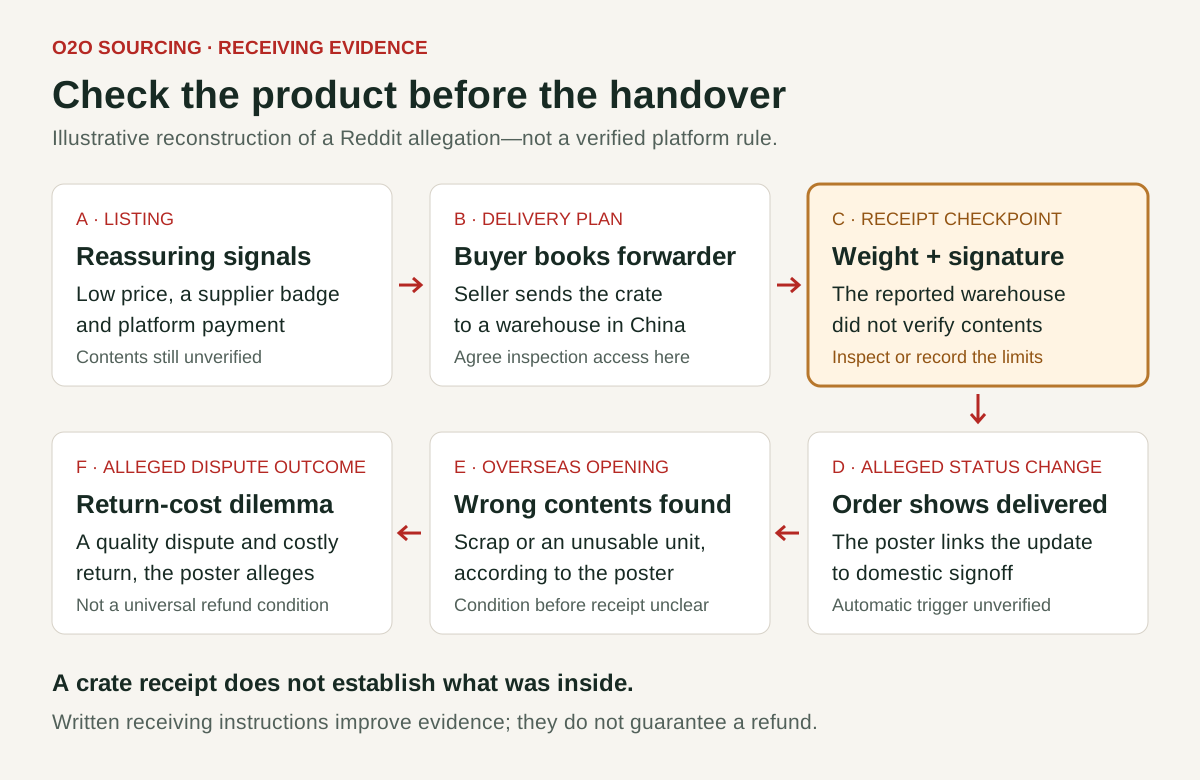
The decisive gap is between receiving a package and checking the promised product. The thread’s logistics commenter argues that a clean warehouse receipt gives the seller persuasive paperwork while the buyer still lacks contents evidence. That is a useful question to put to your own forwarder: will the arrival record describe only a crate, or document the actual vehicle and its identifiers?
What Alibaba’s public policy does—and does not—confirm
Alibaba’s published money-back policy includes missing orders and incorrect or defective goods. It describes delivery-based claim windows and eligibility conditions for local returns. This does not support the thread’s blanket proposition that domestic receipt eliminates protection, or that every incorrect-item claim requires buyer-funded international return.
We could not establish the alleged automatic warehouse-signature trigger from accessible official terms. Nor could we verify a rule automatically converting suspected substitution into a lesser dispute category. Treat those mechanisms as the poster’s account. For your order, ask platform support to identify the delivery event, receipt-confirmation process, applicable claim deadline and evidence needed when using your named forwarder. Save the response with the order.
The thread’s strongest practical observation survives that uncertainty: discovering a discrepancy while the crate is accessible in China gives you an earlier opportunity to document it and request a resolution. It does not guarantee a refund. A signature annotated with an exception is evidence of that exception; it is not a switch that reliably controls the platform’s order status.
A buyer-appointed forwarder is not, on its own, the warning sign
There is a substantive disagreement in the discussion. The poster treats insistence on a domestic forwarder as central to the alleged scheme. A commenter identifying as a logistics practitioner responds that buyers routinely appoint forwarders. Their narrower concern is an unchecked handover combined with convincing delivery paperwork. You can accept that distinction without accepting the commenter’s claims about guaranteed dispute outcomes.
The commenter groups FOB and EXW together too loosely. The ICC’s Incoterms checklist distinguishes delivery at the seller’s premises under EXW, delivery to the carrier at the agreed point under FCA, and onboard delivery under FOB. A warehouse signature should not be described as the universal FOB risk-transfer event. Contractual delivery, transport risk and a platform’s status display require separate checks.
Another contributor focuses on a different combination: an unusually cheap branded vehicle, doubtful authorization and inconsistent identification details. The poster agrees that buyers should investigate, while maintaining that badges can mislead newcomers. For the detailed supplier work, use our low-priced overseas vehicle screening guide. Here, the immediate decision is whether the goods can be inspected before an unchecked handover proceeds.
In the poster’s account, asking for a chassis identifier produced an explanation of the vehicle’s year that they believed was inconsistent. The poster says the seller then retreated from that explanation. The discussion contains competing assertions about decoding, but supplies no independently authenticated vehicle record establishing the unit’s identity or ownership. Another commenter describes positive purchases in other product categories, then acknowledges not having bought vehicles. That experience does not directly resolve the vehicle allegation. Together, these exchanges expose how easily reassurance about a seller or platform can answer a different question from the one the buyer actually needs settled.
The poster also alleges that verification badges involve little more than paid paperwork. Alibaba’s Verified Supplier description describes third-party onsite verification and an assessment report. Read the actual report’s scope rather than adopting the accusation. As a purchasing inference, an assessment of a business cannot establish the contents of your particular sealed crate.
Give the warehouse instructions before dispatch
The logistics commenter recommends opening the crate, photographing the vehicle identification number or data plate and recording exceptions on the proof of delivery. The proposal is more useful than simply telling buyers to be careful: it identifies a receiving task that must be assigned before arrival. But the comment does not establish that every warehouse offers those services, or that adding a note prevents an automatic delivery update.
Ask your forwarder to confirm the service, access, handling arrangements and charges in writing. For a vehicle crate, establish who can open and repack it safely, whether an inspector must attend, and what happens if access is refused. Agree the distinction between taking physical custody and accepting the product as conforming. If the warehouse cannot inspect before the carrier requires a receipt, arrange the product inspection earlier at the seller’s premises.
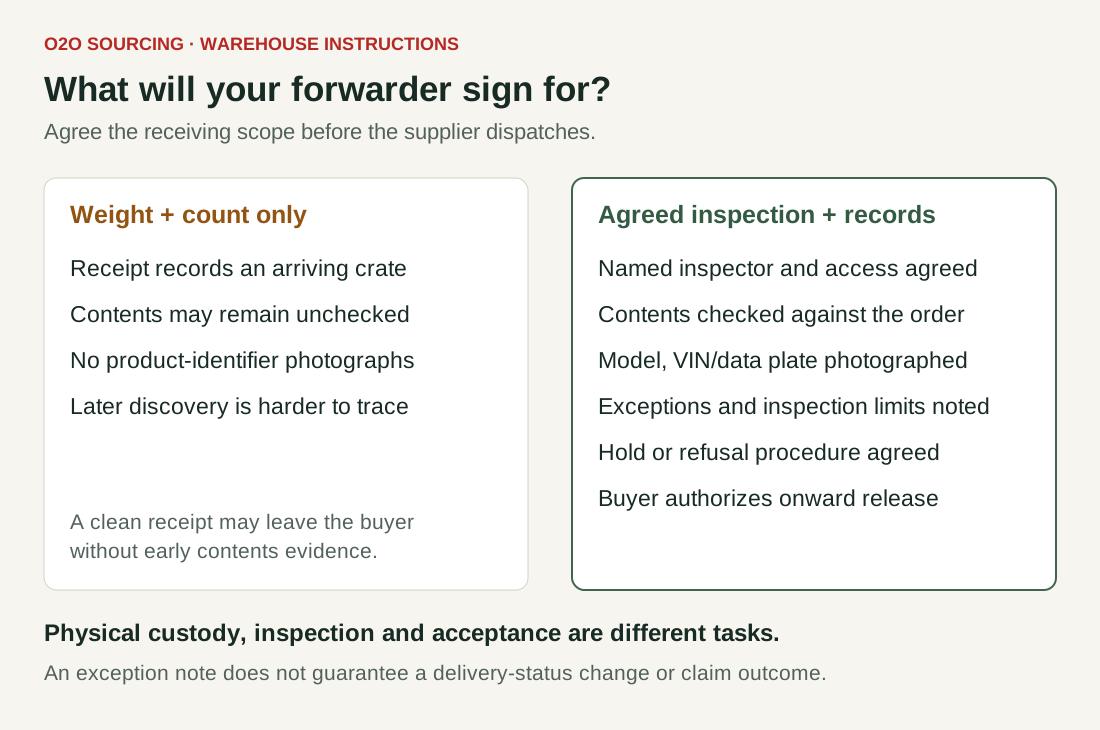
Adapt this instruction with the warehouse and seller; obtain their agreement before dispatch:
For order [reference], confirm inspection access before arrival. Photograph the crate, labels and seals. Have [named party] check contents, model, quantity and VIN/data plate against the order. Record inspection limits. If contents differ or access is refused, contact [buyer contact] and follow the agreed hold or refusal procedure. Obtain our written export release. Do not describe unchecked goods as inspected and accepted.
Adapt this template with your warehouse using our forwarder handoff-plan guide. Record agreed product and inspection requirements in the platform order; retain supporting messages, photographs and reports.
Can independent inspection close the gap?
A reader in the thread asks whether paying for independent inspection would avoid the alleged problem; no substantive answer was identified in the comments reviewed. The timing matters. An inspection after overseas arrival may describe the discrepancy, but it cannot recreate the condition of the contents before the warehouse signed. An earlier product check addresses a different evidential gap.
QIMA’s pre-shipment inspection description covers checks against specifications, quantities and packaging before dispatch. For a vehicle, agree a product-specific scope and identify exactly which unit is checked. Our recommendation is to connect that report to dated identifier photographs, crate markings and subsequent handover records. A generic factory report or a closed-crate weight does not answer the same question.
The thread’s logistics contributor recommends inspection before balance payment and dispatch. That is a practical proposal to negotiate into your order, not an automatic entitlement. If the seller refuses agreed access or the inspected unit cannot be linked to the departing crate, pause the shipment. Inspection can identify discrepancies within its scope; it cannot authenticate every document or guarantee platform recovery.
If the wrong contents are already discovered
The thread describes buyers facing a choice between expensive return freight and a partial refund. The poster presents that as a recurring trap, but provides no basis for treating a particular refund percentage or return instruction as inevitable. For your own case, preserve the actual resolution terms and ask who pays return handling, carriage and associated charges before agreeing to ship anything back.
Keep the order, product description, payment reference, warehouse receipt, tracking history, inspection report and opening photographs together. Preserve packaging and identifiers where safe. Describe the discrepancy accurately in the platform claim, including any mismatch between the agreed destination and the displayed delivery event. Request clarification promptly; do not wait for a warehouse hold or seller negotiation to pause a deadline automatically.
Several commenters favor card payment and chargeback, while another reports missing an issuer’s deadline. One reports a fast result; another describes using a different payment provider after card recovery failed. Those experiences do not establish a universal deadline, coverage promise or recovery time. They show why you need your own issuer’s answer before relying on that route.
Other payment replies differ in what they would accept before ordering. A contributor describes requiring platform-arranged shipping, an extended protection arrangement and card payment together. Others simply ask why a buyer would not dispute the charge. The poster responds that recovery requires evidence and that not every bank accepts every request. These are individual views about a fallback, not proof that the proposed combination removes the receiving problem. The unsuccessful card-recovery account also involved a different payment provider and a split invoice. Its outcome cannot establish what would happen to a buyer using another issuer, transaction structure or delivery agreement.
Visa’s UK guidance describes possible purchase-dispute recovery, subject to conditions, and says recovery is not guaranteed. American Express’s US guidance directs customers to contact the merchant and use its transaction dispute process. Ask your issuer about your card, country, payment route, expected-delivery date, evidence and deadline. Disclose existing refunds and open platform claims; never seek duplicate recovery.
Your next shipment: the signoff checklist
The useful lesson from the Reddit exchange is the question its competing accounts expose: who has checked the product before your receiving paperwork is created? You do not need to assume that every buyer-appointed forwarder is dangerous, or that a platform badge guarantees the shipment, to resolve that question.
- Match the intended unit and identifiers to the agreed order; resolve access refusals before dispatch.
- Record the delivery term, named place and responsibilities for inspection, custody and release.
- Have the forwarder confirm its receiving scope and the hold, exception or refusal procedure.
- Schedule the product inspection before the handover you intend it to inform.
- Keep the inspected unit traceable through packing, warehouse receipt and export release.
- Save the platform’s applicable claim dates and your payment provider’s dispute instructions.
- Release onward freight only after the agreed evidence has been reviewed and discrepancies resolved.
Questions & discussion
Share a question or a useful experience about this guide. Comments appear immediately. Your name and comment are public. Email is optional and stays private; reply emails are not enabled yet. Comment privacy.