
What Does Made in PRC Mean? Read the Origin Label Carefully
PRC refers to China, but that does not make every abbreviation acceptable on an import label. Separate origin, quality and destination marking requirements.
“Made in PRC” refers to manufacture in the People’s Republic of China. It does not describe a separate country, a higher quality tier or a certification. Recognizing the abbreviation is one question; deciding whether it satisfies a destination’s legal marking rules is another.
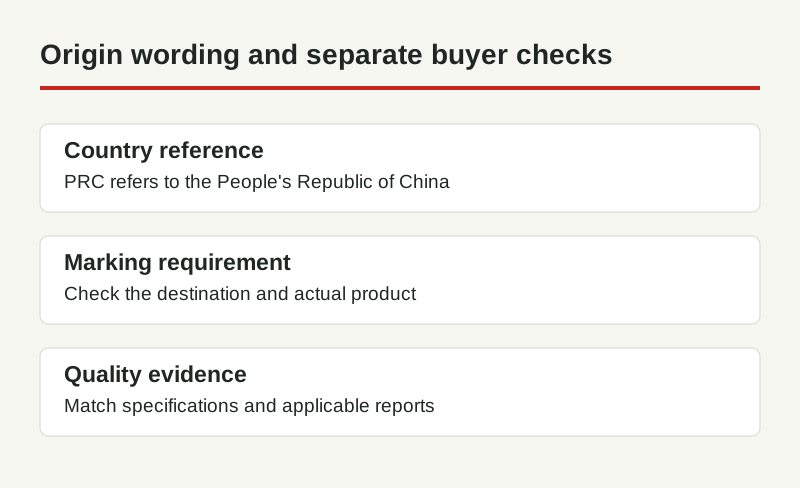
Made in PRC and Made in China: same country reference
| Wording or claim | What it tells you | What it does not establish |
|---|---|---|
| Made in PRC | A reference to manufacture in China | Acceptance of the abbreviation in the importing market |
| Made in China | An express country reference | Product quality, safety or regulatory approval |
| Designed in another country | A design claim | Where manufacturing occurred |
| Shipped from another country | Dispatch location | Customs origin of the goods |
| A certification mark | A claim under the named scheme | Origin unless that scheme expressly verifies it |
The label cannot tell you which factory made the goods, whether the production sample matches the shipment or which test report applies. Ask for those records separately. A familiar brand or unfamiliar country abbreviation does not change that work.
A US buyer should not assume PRC is acceptable marking
In its published ruling NY N262161, U.S. Customs and Border Protection rejected PRC as a country-of-origin marking abbreviation in the circumstances discussed. See the CBP ruling. CBP’s country-of-origin marking guidance explains the broader marking framework.
For a US order, have the importer and customs broker confirm the required wording, visibility, permanence and placement for the actual goods. Do not replace “China” with “PRC” merely because a supplier says other customers use it. A ruling about one set of goods is also not a substitute for checking current requirements and applicable exceptions for yours.
This is a labeling checkpoint, not a determination of your product’s legal origin. Goods processed in more than one country may need a separate origin analysis. Packaging or dispatch from a different country does not resolve that analysis.
Origin is not a product quality grade
Judge the offered product against its specification: material, dimensions, construction, function, finish and relevant compliance evidence. Two goods carrying the same country label can have different designs, components and quality controls. Neither PRC nor China means that a sample was independently tested.
For textiles sold in the United States, origin sits alongside other labeling obligations. The FTC textile-labeling guide covers fiber content, origin and responsible-business identification. Checking a country phrase alone does not complete a garment label review.
A practical label-proof checklist
Request the complete artwork for the product, retail package and outer carton. A cropped photo may hide contradictory wording on another face. Match the model, material and responsible company to the order documents, then confirm whether the label must stay with the goods after unpacking.
Keep the approved artwork version with the purchase order. Inspect placement and legibility on production units as well as on the design file. If a supplier proposes a wording change, record it as a specification change and obtain destination-specific confirmation before accepting it.
If a product has already arrived with questionable marking, ask the importer and broker about the appropriate response. Adding a sticker without checking the conditions may not resolve the issue. The useful next step is a clear record of the goods, existing wording and intended market, not a blanket reassurance about an abbreviation.
Next steps
Supplier verification guides · Gross and net weight
Sources
- CBP origin marking
- CBP ruling NY N262161
- FTC textile labeling
Questions & discussion
Share a question or a useful experience about this guide. Comments appear immediately. Your name and comment are public. Email is optional and stays private; reply emails are not enabled yet. Comment privacy.