
China to US Sizes: Convert Measurements Before Labels
Use clothing measurements, a centimetre-to-inch table and a footwear comparison record to check China-to-US size claims before ordering.
There is no dependable rule that a Chinese L always equals a US S or that every Chinese shoe code converts to one US size. Convert the measurements first, then use the exact brand or supplier chart for the selected style. This page gives a clothing reference, a shoe comparison worksheet and a repeatable way to approve your own size chart.
Clothing: start with the measurement basis
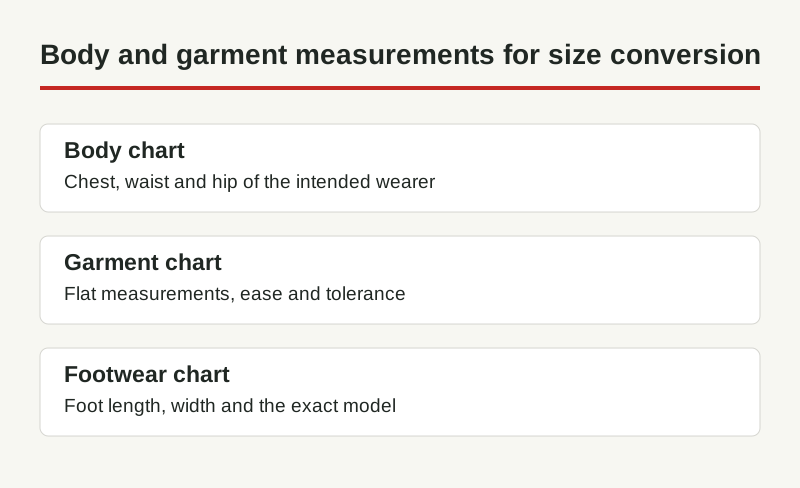
Ask whether the chart describes the wearer’s body or the finished garment. Chest circumference is not the same measurement as a shirt laid flat from armpit to armpit. A doubled flat width is a garment circumference; it still includes design ease, stretch and construction differences. Never compare one directly with a body-size table without checking that distinction.
| Chinese listing information | What you need for a US comparison | Conversion status |
|---|---|---|
| S, M, L or XL alone | Exact style’s body or garment measurements | Not established from the letter alone |
| Height and chest code, such as 170/88 | Supplier’s explanation of the code and intended body dimensions | A body reference, not a universal US letter |
| Chest, waist and hip in cm | Same measurement positions in the target US chart | Divide centimetres by 2.54 |
| Flat garment width in cm | Garment circumference and agreed ease | Double width only if the measurement method supports it |
| Children’s age label | Height, body measurements and exact style chart | Not established from age alone |
The Nike men’s tops chart explicitly uses body measurements. Its regular men’s chest bands below are one brand’s reference, not an Asian-to-American standard. Match a supplier’s intended body range to these bands only when you are deliberately targeting that fit system.
| Nike men’s US alpha reference | Body chest, cm | Body chest, inches, rounded |
|---|---|---|
| S | 88–96 | 34.6–37.8 |
| M | 96–104 | 37.8–40.9 |
| L | 104–112 | 40.9–44.1 |
| XL | 112–124 | 44.1–48.8 |
Women’s, children’s and tall styles require their own tables. These men’s rows cannot establish a women’s numeric size or a dress size. Record the target chart’s date and URL with the purchase specification so a later chart revision does not silently change the order.
Centimetres to inches: a neutral conversion table
The inch equals exactly 2.54 cm; the following values are arithmetic rounded to two decimal places. This changes units, not fit. The NIST SI guide supplies the unit-conversion basis.
| Measurement, cm | Inches |
|---|---|
| 20 | 7.87 |
| 25 | 9.84 |
| 30 | 11.81 |
| 60 | 23.62 |
| 80 | 31.50 |
| 100 | 39.37 |
For example, an invented sample with a flat chest width of 50 cm has a nominal doubled circumference of 100 cm, or 39.37 inches. It does not follow that it fits a person with a 100 cm chest: the required ease depends on the design, fabric and intended fit. Measure a known acceptable garment using the same method and compare the sample with that garment.
Shoes: do not treat the box’s CM number as foot length
The Nike men’s footwear guide distinguishes foot length from the CM size printed on boxes and labels. That is why a generic equation from a Chinese code to a US shoe number can be misleading. Width, last, model and sock allowance also matter.
| Starting information | Conversion or check | US size outcome |
|---|---|---|
| Measured foot length: 250 mm | 25.0 cm = 9.84 in | Use the selected model’s foot-length row |
| Measured foot length: 260 mm | 26.0 cm = 10.24 in | Use the selected model’s foot-length row |
| Measured foot length: 270 mm | 27.0 cm = 10.63 in | Use the selected model’s foot-length row |
| Supplier label “40” only | Ask which sizing system and last it represents | Not established |
| Insole length only | Ask for intended foot length and fitting allowance | Not established from insole length alone |
Those lengths illustrate unit conversion, not recommended size assignments. For a US listing, save the exact model chart rather than borrowing an unrelated brand’s numeric table.
Approve a size chart before approving production
- Define the wearer group, target fit and destination chart.
- Request measurement diagrams, units, tolerances and whether figures describe bodies or garments.
- Measure a sample at the stated points. Check stretch and the stated wash condition separately.
- Confirm every size in the grading range; one medium sample does not validate larger sizes.
- Attach the approved chart and sample reference to the order, packaging and consumer listing.
Keep an exception column for any failed measurement and agree the remedy before placing the bulk order. For online sales, publish the measurement instructions beside the chart. An honest product-specific table is more useful than a confident universal conversion that the supplier cannot reproduce.
Next steps
1688 buying guide · Supplier verification guides
Sources
- Nike men’s tops measurements
- Nike men’s footwear measurements
- NIST Guide to the SI
Questions & discussion
Share a question or a useful experience about this guide. Comments appear immediately. Your name and comment are public. Email is optional and stays private; reply emails are not enabled yet. Comment privacy.