
Gross Weight vs Net Weight: What Goes on the Packing List?
Separate product net mass, packed cargo gross mass, container tare and chargeable weight with a worked packing-list example.
Net weight describes the goods on the stated basis; packed cargo gross weight adds the packaging on that same basis. A container’s verified gross mass is a different total because it also includes container tare. Write the boundary next to every number before comparing a supplier quote, freight charge or packing list.
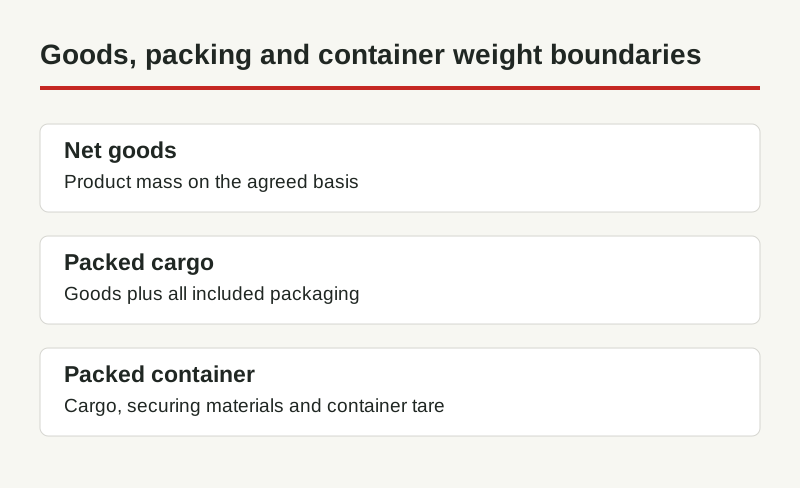
Three boundaries that prevent expensive confusion
| Term | What it measures | What to specify in your order record |
|---|---|---|
| Product net weight | Goods excluding the packing defined separately | Per item, per carton or shipment; accessory treatment |
| Packed cargo gross weight | Goods plus boxes, protection, pallets or crates included in that total | Whether pallet and consolidation packing are included |
| Packed-container gross mass | Cargo, packing, securing materials and container tare | Shipment-specific verified mass and container identity |
| Chargeable weight | Carrier’s billing basis | Actual or dimensional weight, service rules and divisor |
Use kg consistently, with the quantity and measurement date. “Gross 20” without a unit or package boundary is not usable shipping information. A supplier may quote a carton while the forwarder quotes a palletized shipment, so apparent discrepancies can be legitimate additions rather than arithmetic errors.
The IMO verified-gross-mass guidance describes weighing a packed container or, under an approved method, adding cargo, packing and securing mass to the container tare. A supplier’s estimated goods weight is not that declaration.
Worked example: from pieces to a shipment
These are invented arithmetic inputs, not product data, carrier rates or a loading limit. Suppose there are 100 pieces, each with net mass 0.8 kg. Ten pieces go into each carton; the combined carton and internal packing add 1.2 kg per carton. The shipment uses ten cartons and one 15 kg pallet.
| Calculation | Result |
|---|---|
| Net goods: 100 × 0.8 kg | 80 kg |
| Net goods per carton: 10 × 0.8 kg | 8 kg |
| Gross per carton: 8 + 1.2 kg | 9.2 kg |
| Ten cartons: 10 × 9.2 kg | 92 kg |
| Palletized cargo: 92 + 15 kg | 107 kg |
Do not add the pallet again if it is already inside the quoted cargo gross figure. Conversely, a total of 92 kg cannot represent the complete palletized cargo in this example. Container tare and any additional securing materials remain outside this 107 kg boundary.
Freight billing: mass and volume answer different questions
A light but bulky carton can be charged on dimensional weight. The exact rule depends on the carrier, route and service; do not copy a universal divisor into a purchase order. DHL’s volumetric-weight explanation describes why space can govern the charge. Get the forwarder’s written method and use the final packed outside dimensions.
Ask the supplier for a preliminary packing plan when comparing quotations, then replace estimates with final counts, dimensions and measured weights after packing. Repacking, extra corner protection and palletization can change both weight and chargeable volume. A product’s catalogue weight cannot close the freight budget on its own.
What to put on the packing list
Use package IDs that connect the physical cartons to the list. Record quantity, product description, dimensions, net mass and gross mass on one consistent basis. Include a separate line for a pallet or explain how its mass is allocated. If cartons differ, list the differences rather than multiplying one convenient sample by the whole order.
For customs, confirm the required net-weight basis and commodity units with the broker or destination authority. Some goods have product-specific definitions or supplementary units. This guide explains record reconciliation; it does not establish the customs treatment of your commodity. The U.S. International Trade Administration’s packing-list overview describes the document’s trade role and common shipment details.
A final reconciliation before dispatch
Match the goods count to the invoice, the package count to the warehouse record, and each gross weight to the packing arrangement actually used. If the measured shipment differs from the quotation, ask which input changed: goods, moisture, packaging, pallet, dimension or count. Keep the explanation with the revised booking.
An unexplained difference should stay open until the supplier and forwarder agree the boundary. Do not solve it by editing a number to match an old freight quote. The useful record is the one that describes the shipment being moved.
Next steps
1688 total-cost check · Orders, quality and shipping
Sources
- IMO packed-container gross mass
- DHL volumetric weight
- ITA packing lists
Questions & discussion
Share a question or a useful experience about this guide. Comments appear immediately. Your name and comment are public. Email is optional and stays private; reply emails are not enabled yet. Comment privacy.