

Private Sourcing Agent with a Warehouse: QC and Repacking Checklist
Define warehouse ownership, inspection evidence, repacking scope and UK shipping responsibilities before a paid one- or two-SKU sourcing-agent trial.
1. Decide whether you need purchasing or a complete fulfilment chain
Imagine a small UK shop buying lightweight products, perhaps 100–300 g each, from 1688 or a Chinese factory. You want someone to buy the goods, receive them, inspect them, replace unwanted outer packaging and send a traceable parcel to the UK. That is the service boundary to put in your enquiry.
Treat a recommendation as a candidate for a paid trial. The checklist below is a proposed way to compare candidates; it has not been validated through an agent trial and does not guarantee reliable performance. It offers no verified agent recommendation, market price range or delivery-time promise.
Start with one order specification: product category, SKU, quantity, destination, packaging requirements and your release criteria. Lightweight goods still need packed dimensions recorded. Ask each candidate to quote against the same specification.
2. Which steps will the agent actually perform?
Ask the agent to complete this responsibility map before discussing an all-in price. For every outsourced step, name the operator and the person who remains accountable to you.
| Step | Ask the agent | Keep before the next handoff |
|---|---|---|
| Purchase | Who places the supplier order, and in whose name? | Agreed SKU, specification, quantity and purchase record |
| Warehouse receipt | Who operates the premises and records stock? | Receiving count, dated photos and discrepancy report |
| Inspection | What is checked, how many units and against which criteria? | Inspection scope, results and defect photos |
| Repacking | Who supplies materials and approves the finished pack? | Approved pack sample and before/after photos |
| Consolidation | Who assigns carton contents and shipment marks? | Carton-level packing list, weight and dimensions |
| UK dispatch and clearance | Who books transport and arranges each import task? | Written transport scope and named responsible parties |
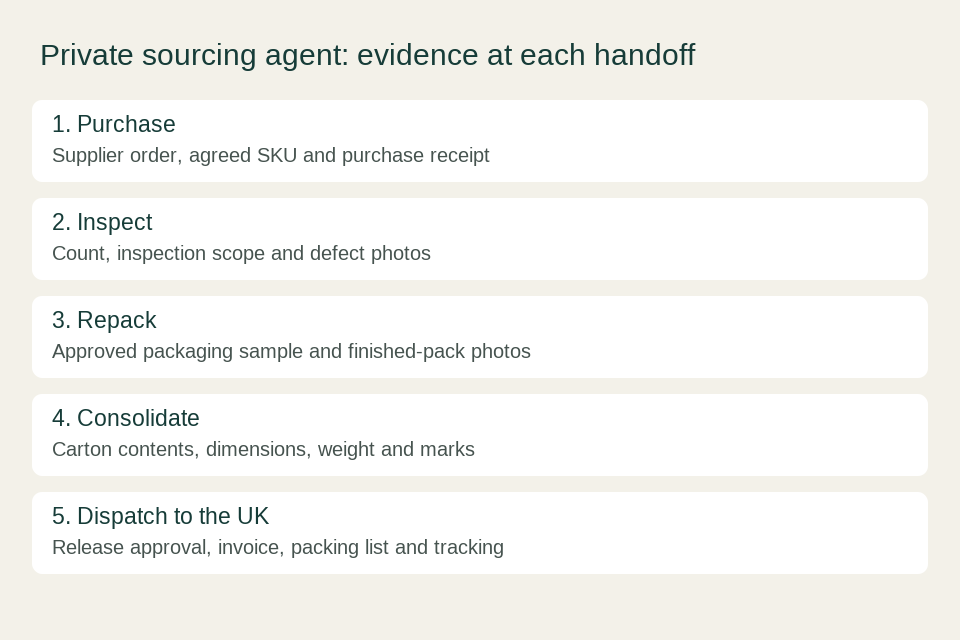
For the purchasing stage, use the 1688 buying guide to prepare the supplier enquiry. Keep this page focused on what happens between purchase and release from the warehouse.
3. What would establish the warehouse claim?
Request the legal entity name, registration details, warehouse address, contracting entity, invoice sample and payment beneficiary. Ask whether the premises are owned, leased or operated by a third party. If ownership is a firm requirement, request relevant supporting documents and arrange verification appropriate to the order before paying.
A warehouse video or an address alone does not establish ownership or show that your order will be processed there. Ask for a live walkthrough tied to your enquiry and a redacted receiving record. Reconcile the business names across the contract, invoice, payment instructions and warehouse documents; request a written explanation for differences.
Separate physical access from service capability. Ask who can authorise inspection, quarantine stock, approve repacking and release cartons. Agree whether you or an independent inspector can access your goods. Use the sourcing-agent shortlist to identify candidates, then apply the same checks to each.
4. How should you run a one- or two-SKU trial?
Use a small paid order with one or two SKUs and a spending ceiling you set in advance. Write down the sample or specification revision, quantity, inspection points, packaging approval and dispatch conditions. This is an operating proposal, not a proven screening formula.
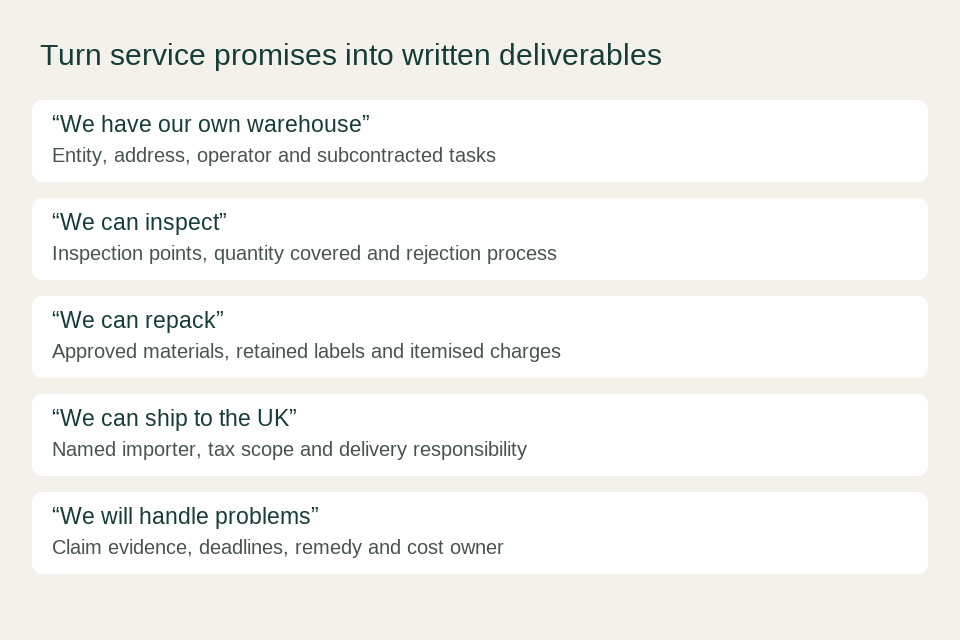
Require a receiving count and SKU-labelled photos. Specify the inspection coverage and the defects that trigger a hold. A photograph of an unopened carton cannot answer a request to check product function. Use the pre-shipment inspection checklist to define the actual checks; do not assume an agent’s routine warehouse check covers them.
Give a written repacking instruction with approved materials, labels to retain, carton marks and consolidation rules. Require finished-pack photographs, a carton list and your written release approval before dispatch. If a discrepancy appears, record the proposed remedy, cost owner and revised schedule before allowing work to continue. You can ask the agent to explain a hypothetical defect case without staging damage or inventing an incident.
Compare the trial against your own acceptance criteria:
| Review area | Evidence to compare | Decision to record |
|---|---|---|
| Communication | Answers, promised response times and actual timestamps | Were missing answers resolved before payment or release? |
| Documents | Entity details, invoice, stock record and packing list | Do names, SKUs and quantities reconcile? |
| Exceptions | Written hold and remedy process; actual cases if any occurred | Who authorises the remedy and pays? |
| Cost | Quote, changes, final invoices and delivery charges | Which costs remain unresolved? |
Build a comparison ledger for product cost, China delivery, agent service, inspection, storage, packaging, consolidation, international carriage and destination charges. Mark each item included, excluded or awaiting confirmation. Add tax and duty amounts only when supported for the actual shipment. Keep estimates separate from final paid costs. Our agent-fee guide covers fee models; this trial needs an order-specific ledger, not an assumed market average.
5. What needs an answer before UK dispatch?
Ask these questions in writing and have the parties responsible for import arrangements confirm their answers:
- Who will be the importer of record for this shipment, and which entity details will appear in the documents?
- Who will make or arrange the declaration, and what information must you supply?
- Which delivery terms apply, and exactly which duties, taxes, brokerage and destination charges are included or excluded?
- What product description, classification and value will be used, and who will check them?
- What tracking service and delivery milestone are being promised?
- What evidence and deadlines apply to loss or damage claims, and who pays for an agreed remedy?
- What happens if goods fail inspection before dispatch, and who authorises rework, return or disposal?
These are questions to resolve for your shipment, not answers about UK import law. No duty rate, tax treatment or customs procedure is established here. Do not release the order while responsibility or a material charge is unresolved. Compare transport proposals with the freight-forwarder checklist.
6. Who should repack the goods, and who pays?
Get two written proposals where practical: factory packing with buyer-approved materials, and warehouse repacking after receipt. Ask the factory whether it accepts buyer-supplied packaging and request a separate packing quotation. Ask the agent to itemise materials, labour, storage, rejected packaging and any extra transport. Acceptance and charges need confirmation from the actual parties.
Approve one finished pack before the remaining units are repacked. Specify what to remove, what to retain and where the SKU identifier belongs. Ask the responsible compliance party which product, safety and traceability labels must remain. Removing another seller’s outer branding is not evidence that a product may lawfully be relabelled or sold under your brand.
Record who pays if supplied boxes do not fit, a barcode becomes unreadable or repacking damages an item. Reweigh and measure the finished parcel, then obtain a revised shipping quote where needed. Do not assume a bare product’s weight is the carrier’s chargeable weight.
7. Should you use an agent, employ someone or manage purchasing yourself?
Choose the model by the work you can supervise and the records you need to control.
| Model | What to define before choosing it | What you still need to manage |
|---|---|---|
| Private agent with a warehouse | Contracting entity, warehouse operator, scope and trial evidence | Service boundaries, conflicts, fees and release approval |
| Direct employee in China | Role, supervision, premises and independently checked employment arrangements | Hiring, payroll, stock controls and continuity |
| Self-managed or platform purchasing | Supplier communication, payment, receiving and available fulfilment services | Any inspection, repacking or import task outside the service |
There is no verified salary benchmark or cost crossover established here. Direct employment needs its own assessment; a sourcing recommendation cannot supply that answer. Read the direct sourcing versus agent decision checklist for the wider choice, then return to this order’s handoff map.
8. Keep three checklists with the order
Before contacting an agent
- Write the product category, SKU, quantity, destination and packaging specification; save the revision.
- List every required service; assign a proposed owner to each handoff.
- Request entity details, warehouse-operation evidence and an invoice sample; retain the replies.
- Send the same quotation template to each candidate; save exclusions alongside prices.
Before paying for the trial
- Limit the trial to one or two SKUs; record the spending ceiling.
- Match contracting and payment names; retain explanations and supporting documents for differences.
- Agree receiving counts, inspection coverage, defect criteria and photo deliverables in writing.
- Approve packaging, retained labels, carton marks and consolidation instructions; save the signed-off version.
- Record fees, change approval, storage terms and the hold/remedy process.
- Identify the parties responsible for transport and import arrangements; retain their confirmations.
Before authorising dispatch
- Reconcile purchased, received, rejected, repacked and packed quantities; save the reconciliation.
- Review inspection results and finished-pack photos; close exceptions in writing.
- Compare the invoice and carton list with the physical shipment records; retain the approved copies.
- Record final packed dimensions, weight, transport scope and outstanding charges.
- Confirm importer details, tax/charge scope and claim instructions with the responsible parties.
- Send written release approval; save tracking and delivery records for the trial review.
Sources
Reddit discussion · r/1688 · 97 comments
Sourcing information earns its value when it is verified, compared and turned into a decision.
Questions & discussion
Share a question or a useful experience about this guide. Comments appear immediately. Your name and comment are public. Email is optional and stays private; reply emails are not enabled yet. Comment privacy.